
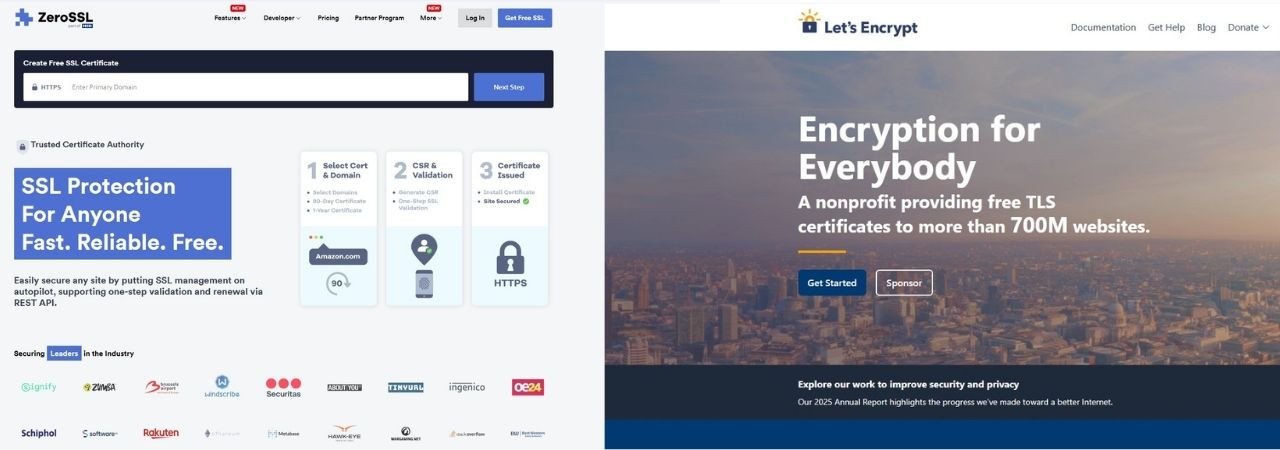
Let’s Encrypt vs. ZeroSSL: Choosing Your Free SSL Certificate
Securing your website with HTTPS is crucial, and free SSL certificates from Let's Encrypt and ZeroSSL make it accessible. While both are trusted Certificate Authorities, they offer distinct approaches to obtaining and managing SSL/TLS, catering to different user needs.
Understanding Free SSL Certificates
In today’s digital landscape, website security is paramount. Encrypting communication between a user’s browser and your website not only protects sensitive data but also builds trust and improves search engine rankings.
This encryption is achieved through an SSL/TLS certificate. Historically, these certificates came with a cost, but that changed with the advent of initiatives like Let’s Encrypt and ZeroSSL.
Both are Certificate Authorities (CAs) that provide free, trusted SSL/TLS certificates. These certificates are recognized and accepted by all major web browsers, ensuring your visitors see that reassuring padlock icon.
While their end goal is the same—to secure the web—their methods, features, and target audiences have some key differences that are worth exploring.
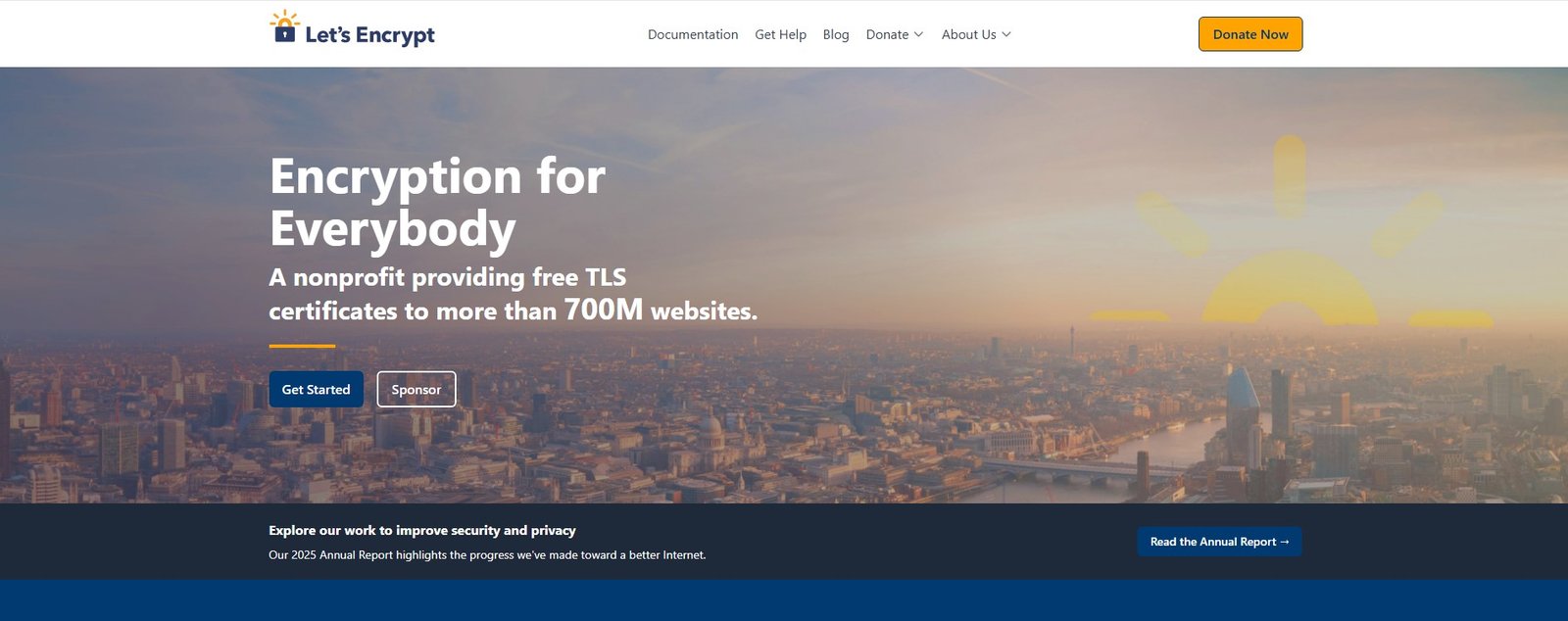
Let’s Encrypt: The Pioneer of Free HTTPS
Let’s Encrypt, launched by the Internet Security Research Group (ISRG), revolutionized web security by offering free, automated, and open certificates. Their mission is to make HTTPS encryption a default for all websites.
They achieve this through the ACME (Automated Certificate Management Environment) protocol, which allows for automated certificate issuance and renewal.
Key Features of Let’s Encrypt
- Completely Free: All certificates issued by Let’s Encrypt are entirely free of charge. There are no hidden fees or premium tiers for their core service. While third-party services might charge to implement Let’s Encrypt for you, the certificates themselves are always free.
- Automated Renewal: Certificates are valid for 90 days, encouraging automation. The ACME protocol, often implemented through clients like Certbot, handles the entire renewal process, minimizing manual intervention.
- Wildcard Certificates: Let’s Encrypt supports wildcard certificates, which can secure a domain and all its subdomains (e.g.,
*.example.com). This is a significant benefit for websites with multiple subdomains. - Community-Driven: As an open-source project, Let’s Encrypt benefits from a large, active community that contributes to its development and offers support.
- Widely Adopted: Due to its free and automated nature, Let’s Encrypt has become incredibly popular, securing hundreds of millions of websites globally.
Ideal Use Cases for Let’s Encrypt
Let’s Encrypt is particularly well-suited for:
- Developers and System Administrators: Those comfortable with command-line tools and server configuration will find Let’s Encrypt’s automation powerful and efficient.
- Open-Source Projects: Its open and free nature aligns perfectly with the ethos of many open-source initiatives.
- Web Hosts and Service Providers: Many hosting providers integrate Let’s Encrypt directly into their control panels, making it easy for their users to enable HTTPS.
- Anyone Seeking Cost-Effective Security: For individuals and businesses looking to secure their websites without incurring additional costs, Let’s Encrypt is an excellent choice.
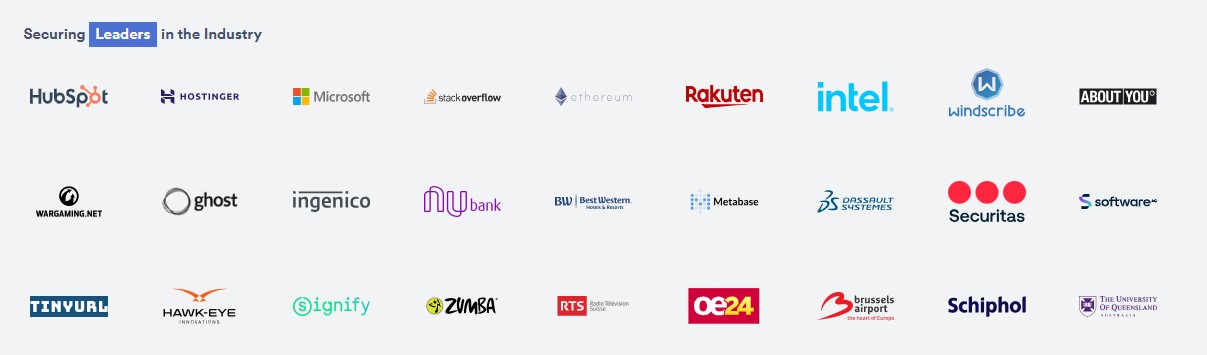
ZeroSSL: User-Friendly Automation with Flexible Options
ZeroSSL emerged as another strong contender in the free SSL certificate space, often seen as a user-friendly alternative or complement to Let’s Encrypt. While it also leverages the ACME protocol, ZeroSSL offers a more guided and intuitive experience, particularly for those less familiar with server-side configurations.
Key Features of ZeroSSL
- User-Friendly Interface: ZeroSSL provides a web-based interface that simplifies the certificate generation and management process. This can be a significant advantage for users who prefer a graphical interface over command-line interactions.
- ACME Client Support: Like Let’s Encrypt, ZeroSSL fully supports the ACME protocol, allowing for automated certificate issuance and renewal through compatible ACME clients.
- Free Tier with Limitations: ZeroSSL offers a free tier that includes up to three 90-day SSL certificates. These can be single-domain, multi-domain, or wildcard certificates. For more certificates or advanced features, paid plans are available.
- Paid Plans for Enhanced Features: ZeroSSL offers various paid plans that unlock additional benefits. These can include unlimited certificates, longer certificate validity (up to one year), SSL monitoring, API access, and dedicated customer support. Pricing for these plans typically ranges from $9.99 to $169.99 per year, depending on the features and protection included.
- SSL Monitoring and Tools: Beyond just issuing certificates, ZeroSSL provides tools for SSL monitoring, helping users stay on top of their certificate status and avoid expirations.
Ideal Use Cases for ZeroSSL
ZeroSSL is particularly beneficial for:
- Small Business Owners and Bloggers: The intuitive interface and free tier for a few certificates make it easy for non-technical users to secure their sites.
- Users Seeking a Guided Experience: If you’re new to SSL certificate management and prefer a step-by-step process, ZeroSSL’s web interface is very helpful.
- Developers Requiring API Access: ZeroSSL offers an API for integrating certificate management into custom applications and workflows.
- Those Who Need More Than Three Certificates (Paid Plans): For users managing multiple websites beyond the free tier, ZeroSSL’s paid plans offer scalability and additional features.
Comparing Let’s Encrypt and ZeroSSL
While both CAs provide essential free SSL/TLS certificates, their approaches and offerings diverge in several key areas. Understanding these differences can help you make an informed decision for your specific needs.
Automation and Integration
Let’s Encrypt’s strength lies in its deep integration with the ACME protocol, making it a favorite for server administrators and developers who prioritize automation. Tools like Certbot streamline the entire process from issuance to renewal. Let’s Encrypt is designed to be a programmatic solution.
ZeroSSL also supports ACME clients, offering similar automation capabilities. However, it distinguishes itself with its web-based dashboard, which provides a more visual and guided approach for manual certificate generation and management.
This can be less intimidating for users who are not comfortable with command-line interfaces.
Cost and Features
The core difference often boils down to their business models. Let’s Encrypt is a non-profit organization, and all its certificate services are entirely free, without any paid tiers or premium features. Their focus is solely on universal HTTPS adoption.
ZeroSSL operates on a freemium model. While it offers a robust free tier for up to three certificates, it also provides paid subscriptions. These paid plans unlock features like unlimited certificates, longer validity periods (up to one year), advanced SSL monitoring, and priority support.
This makes ZeroSSL a scalable solution for users whose needs grow beyond the free offering.
Certificate Types
Both CAs provide standard domain-validated (DV) SSL certificates, which are suitable for most websites. Both also support wildcard certificates, which are crucial for securing multiple subdomains under a single certificate.
Multi-domain certificates are also available from both providers, allowing you to secure several distinct domain names with one certificate.
Support and Documentation
Let’s Encrypt primarily relies on its extensive documentation and a vibrant community forum for support. While direct technical support is not offered, the community is highly knowledgeable and often provides quick solutions to common issues.
ZeroSSL offers a knowledge base and, for its paid users, dedicated customer support. This can be a significant advantage for businesses or individuals who require more direct assistance with their SSL certificate management.
Choosing the Right SSL Certificate Provider
The best choice between Let’s Encrypt and ZeroSSL depends largely on your technical expertise, the number of websites you manage, and your preference for features and support.
When to Choose Let’s Encrypt
- You are comfortable with command-line interfaces and server configurations.
- You manage many websites and want fully automated certificate management.
- You prioritize a completely free solution without any upsells.
- Your web host or server environment has direct integration with Certbot or other ACME clients.
If you’re a developer, system administrator, or part of a project that values open source and automation, Let’s Encrypt is an excellent, robust choice. For more insights into various tools, you might want to visit the Bigspy AI Blog.
When to Choose ZeroSSL
- You prefer a user-friendly, web-based interface for managing your certificates.
- You only need to secure a few websites (up to three) for free.
- You anticipate needing more than three certificates or advanced features like longer validity, and are willing to pay for a premium plan.
- You value dedicated customer support and additional tools like SSL monitoring.
ZeroSSL offers a gentler learning curve and a more comprehensive suite of services for those who prefer a managed experience, especially within its paid tiers. You can explore more options and helpful resources on the Bigspy AI Homepage.
Conclusion
Both Let’s Encrypt and ZeroSSL are highly reputable Certificate Authorities that have made significant contributions to a more secure internet by offering free SSL certificates.
They are both trusted by browsers and provide the fundamental security needed for HTTPS. The choice between them often comes down to a trade-off between absolute freeness and enhanced user experience or additional features.
For those deeply embedded in server management and automation, Let’s Encrypt’s command-line focus and complete freeness make it an ideal solution. For individuals and small businesses seeking a more guided, user-friendly approach, or who might eventually need a scalable paid solution with more features, ZeroSSL presents a compelling alternative.
Regardless of your choice, securing your website with an SSL certificate is a crucial step towards building a safer online presence. Discover more about essential tools and services by browsing our Categories or checking out our Listings for popular and Featured products.
Featured listings


Kyma API
AI Tools


QR Code AI
AI Tools


ZeroSSL
Security