
Pricing details available on the official website.
Kyma API
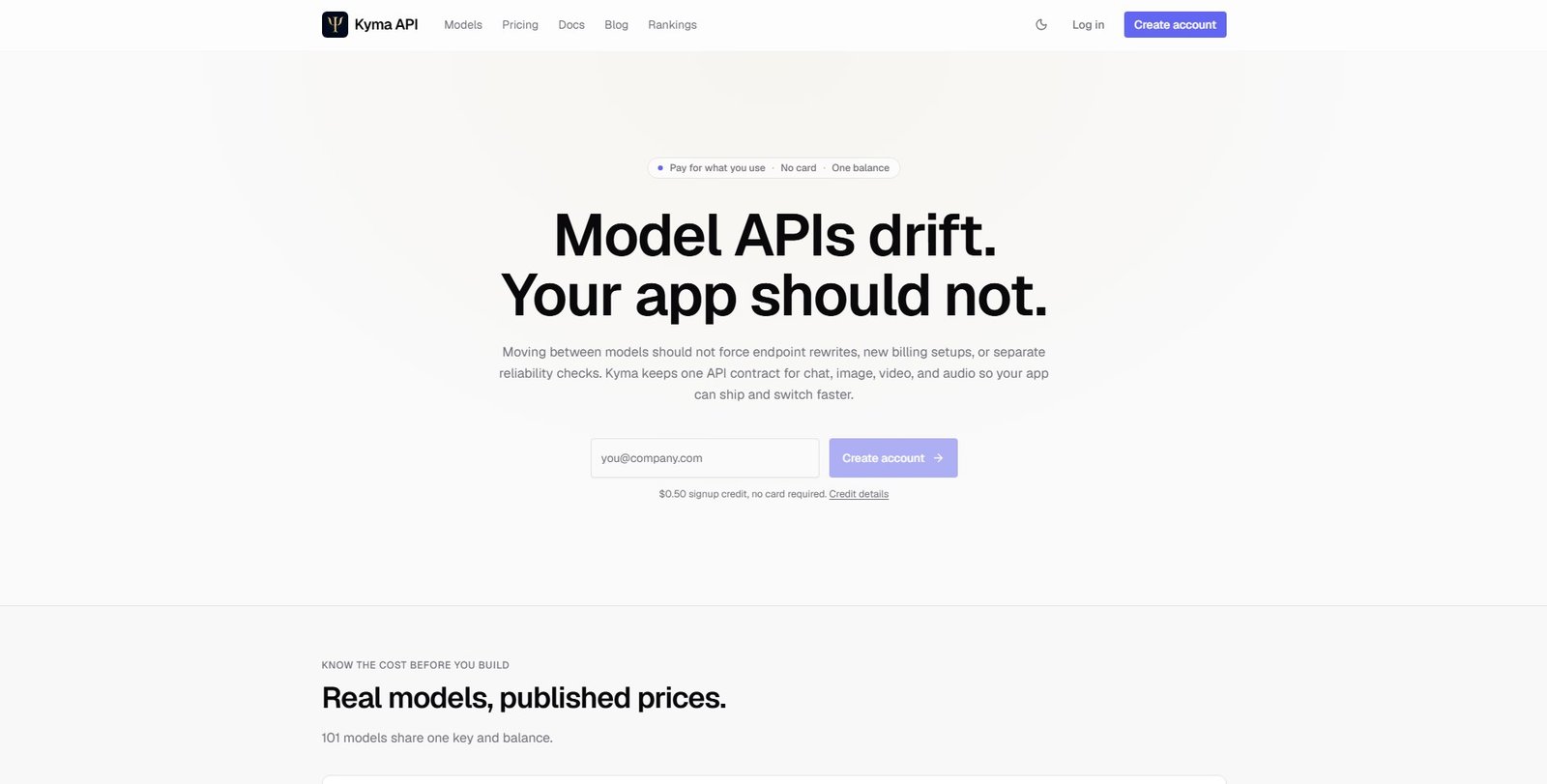
Kyma API is an AI model gateway and aggregator that lets you access over 100 open-source and frontier AI models (including text, image, video, and voice) using a single OpenAI-compatible URL and API key.
Key features
- Unified API Endpoint
- Single API Key Management
- Broad Model Support (100+ models)
- Model Aggregation
- OpenAI Compatibility
- Developer-Friendly Documentation
- Scalability
- Cost Optimization Potential
Pros & Cons
Pros
- Simplifies AI model integration with one API key and endpoint
- Access to a wide variety of AI models (text, image, video, voice)
- OpenAI compatibility reduces learning curve for developers
- Reduces operational overhead by centralizing management
- Enables faster prototyping and deployment of AI applications
- Potential for cost optimization through aggregated usage
Cons
- Dependency on Kyma API's service for all AI interactions
- Direct low-level control over individual models might be abstracted
- Specific niche AI models may not be immediately available
- Pricing structure requires careful review for heavy usage scenarios
What Is Kyma API?
Kyma API is an advanced AI model gateway and aggregator designed to simplify access to a vast array of artificial intelligence models. It acts as a centralized platform, allowing users to interact with over 100 open-source and frontier AI models—including those for text generation, image processing, video analysis, and voice recognition—all through a single, unified, OpenAI-compatible URL and API key. Essentially, Kyma API abstracts away the complexity of managing multiple AI model providers and their respective APIs, providing a streamlined interface for developers and businesses to integrate powerful AI capabilities into their applications.
This innovative approach means that instead of needing to learn and implement different APIs for each AI model or provider, users can leverage Kyma API to standardize their AI interactions. Whether you’re working with large language models, sophisticated image generators, or advanced speech-to-text services, Kyma API aims to provide a consistent and efficient pathway to these diverse AI resources. It’s built for developers who need flexibility, broad model access, and simplified integration.
How Does Kyma API Work?
Kyma API functions as an intelligent proxy layer between your application and a multitude of AI models. When you send a request to Kyma API’s unified endpoint, it intelligently routes your request to the appropriate underlying AI model, handles the communication, and returns the processed output. This process is made seamless by its OpenAI-compatible interface, meaning developers familiar with OpenAI’s API structure can quickly get started without a steep learning curve.
The core mechanism involves a single API key that grants access to Kyma’s extensive catalog of models. This eliminates the need to manage dozens of individual API keys and credentials from various providers. Furthermore, Kyma API handles aspects like rate limiting, error handling, and data formatting, ensuring a consistent experience regardless of the specific AI model being used. This abstraction layer significantly reduces development time and operational overhead for teams building AI-powered applications.
By centralizing access, Kyma API also provides a unified monitoring and management experience. Users can track their usage across all integrated models from a single dashboard, simplifying cost management and performance analysis. This aggregation capability is particularly beneficial for projects that require dynamic switching between models or leveraging multiple AI capabilities simultaneously.
Key Features of Kyma API
Kyma API offers a robust set of features designed to enhance the development and deployment of AI-powered applications:
- Unified API Endpoint: Access over 100 AI models through a single, consistent OpenAI-compatible API endpoint.
- Single API Key Management: Simplify security and access control with one API key for all integrated models.
- Broad Model Support: Connect to a diverse range of open-source and frontier AI models, including those for text, image, video, and voice.
- Model Aggregation: Seamlessly switch between different AI models or combine their capabilities within a single application.
- OpenAI Compatibility: Leverage existing knowledge and codebases designed for OpenAI’s API, reducing integration friction.
- Developer-Friendly Documentation: Clear and comprehensive documentation to help developers get started quickly.
- Scalability: Designed to handle varying workloads, from small projects to enterprise-level applications.
- Cost Optimization Potential: Centralized usage tracking can help optimize spending across multiple AI services.
Main Use Cases for Kyma API
Kyma API is versatile and can be applied across a wide range of scenarios where AI integration is crucial:
- AI-Powered Application Development: Developers can rapidly build applications that require diverse AI functionalities without managing multiple vendor APIs. This includes chatbots, content generation tools, intelligent assistants, and more.
- Prototyping and Experimentation: Quickly test and compare different AI models for specific tasks (e.g., trying various LLMs for summarization or different image models for generation) to find the best fit for a project.
- Enterprise AI Integration: Large organizations can standardize their AI infrastructure, making it easier to deploy, manage, and scale AI capabilities across different departments and projects.
- Content Creation Platforms: Integrate text generation, image synthesis, and voiceover capabilities to automate and enhance content production workflows.
- Data Analysis and Automation: Utilize AI models for tasks like sentiment analysis, data extraction from unstructured text, or automated video transcription within analytical pipelines.
- Educational and Research Projects: Provide students and researchers with simplified access to a broad spectrum of AI models for learning and experimental purposes.
Who Is Kyma API Best Suited For?
Kyma API is ideal for a variety of users and organizations looking to streamline their AI development and deployment:
- AI Developers: Those who need to integrate multiple AI models into their applications but want to avoid the complexity of managing various APIs.
- Startups and SMEs: Companies with limited resources that want to leverage cutting-edge AI without significant overhead in API management and infrastructure.
- Enterprises: Large organizations seeking to standardize their AI strategy, reduce vendor lock-in, and improve governance over AI model usage.
- AI Researchers and Data Scientists: Individuals who frequently experiment with different AI models and require a flexible platform to switch between them easily.
- Product Managers: Those who want to quickly prototype and test AI features to understand their viability and impact before committing to specific models or providers.
- Consultants and Agencies: Professionals who build AI solutions for various clients and need a consistent, efficient way to integrate diverse AI capabilities.
Benefits and Practical Advantages of Using Kyma API
Opting for Kyma API brings several significant advantages to the table:
- Simplified Development: A single, OpenAI-compatible API reduces the learning curve and integration time for developers, allowing them to focus on application logic rather than API intricacies.
- Increased Flexibility: Access to over 100 models means greater choice and the ability to select the best-performing model for any given task, or even dynamically switch models based on specific requirements.
- Reduced Operational Overhead: Centralized API key management, usage tracking, and a consistent interface lower the administrative burden associated with managing multiple AI services.
- Future-Proofing: As new AI models emerge, Kyma API can integrate them, providing users with access to the latest advancements without requiring significant code changes on their end.
- Cost Efficiency: By offering a consolidated platform, Kyma API can help users optimize their AI spending by providing insights into usage patterns and potentially offering more favorable pricing models for aggregated usage.
- Faster Time-to-Market: The streamlined integration process enables quicker prototyping and deployment of AI-powered features and products.
Limitations or Considerations
While Kyma API offers many advantages, potential users should consider a few points:
- Dependency on Kyma: Your application’s AI layer becomes dependent on Kyma API’s service availability and performance.
- Model Control: While Kyma aggregates models, direct low-level control or fine-tuning capabilities for individual models might be abstracted or limited compared to direct API access.
- Specific Model Availability: Although Kyma boasts a large number of models, specific niche or proprietary models might not be immediately available through their platform. Users should verify if their required models are supported.
- Pricing Structure: The overall cost might vary depending on usage patterns across multiple models. It’s essential to understand Kyma’s pricing model in relation to direct access costs from individual providers for heavy usage scenarios.
How to Get Started with Kyma API
Getting started with Kyma API is designed to be straightforward, especially for developers familiar with OpenAI’s API. The typical process involves:
- Visit the Kyma API Website: Navigate to the official Kyma API website to learn more and explore their offerings.
- Sign Up for an Account: Create an account to gain access to the platform and your unique API key.
- Obtain Your API Key: Once registered, you will be provided with a single API key that grants access to all available models.
- Review Documentation: Consult the developer documentation to understand how to make requests, specify models, and handle responses using the OpenAI-compatible endpoint.
- Integrate into Your Application: Use your preferred programming language and HTTP client to send requests to the Kyma API endpoint, incorporating the API key for authentication.
- Start Building: Begin experimenting with different models and integrating AI capabilities into your applications, leveraging the simplified access provided by Kyma API.
Frequently Asked Questions
What types of AI models does Kyma API support?
Kyma API supports over 100 open-source and frontier AI models, including those for text generation, image creation, video analysis, and voice recognition (e.g., speech-to-text, text-to-speech).
Is Kyma API compatible with existing OpenAI integrations?
Yes, Kyma API is designed to be OpenAI-compatible. This means if you have existing code or applications built to interact with OpenAI’s API, you can often adapt them to work with Kyma API with minimal changes, primarily by pointing to Kyma’s endpoint and using your Kyma API key.
Do I need multiple API keys for different models?
No, one of the core advantages of Kyma API is that you only need a single API key to access all the models available through their platform. This significantly simplifies API key management and security.
How does Kyma API handle rate limits and errors?
Kyma API acts as an intelligent proxy, managing rate limits and standardizing error responses across the various underlying AI models. This provides a consistent and more predictable experience for your application.
Can I monitor my AI model usage with Kyma API?
Yes, Kyma API typically provides a centralized dashboard or tools to monitor your usage across all integrated AI models, helping you track consumption and manage costs effectively.
Conclusion: Streamlining AI Model Access with Kyma API
Kyma API presents a compelling solution for developers and businesses grappling with the complexities of integrating multiple AI models. By offering a unified, OpenAI-compatible gateway to over 100 diverse AI capabilities, it dramatically simplifies the development process, reduces operational overhead, and accelerates time-to-market for AI-powered applications. Whether you’re building a new product, enhancing an existing one, or simply experimenting with the latest AI advancements, Kyma API provides the flexibility and efficiency needed to unlock the full potential of artificial intelligence.
If you’re looking to streamline your AI integration workflow and gain access to a broad spectrum of AI models through a single, easy-to-use interface, exploring Kyma API could be a highly beneficial next step. Ready to simplify your AI development? Visit the Kyma API website to learn more and get started.
Display your featured badge
Copy this badge into your website footer. Visitors who click it will open this listing page.